Credorium is used in situations where decisions depend on interpretation, context, and shared understanding — not speed, persuasion, or volume of information.
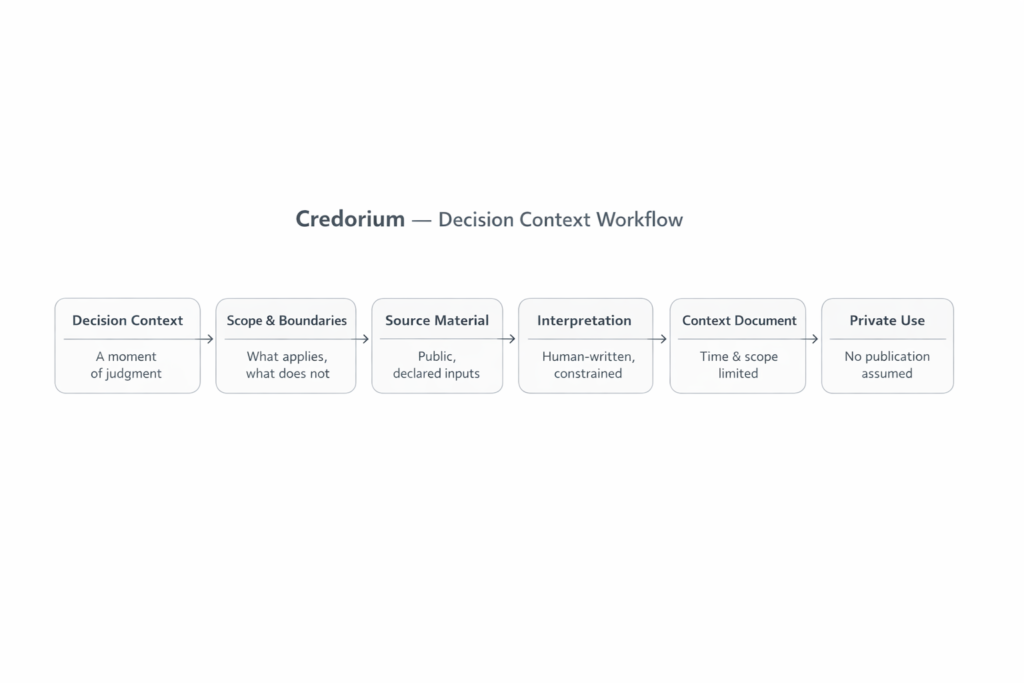
The Graphic above reflects a typical decision-support engagement.
The work supports decision-makers who need clarity before commitments are made, especially when assumptions, automation, or incomplete context could lead to unintended outcomes.
Typical use cases
Credorium is used when:
a decision involves external expertise, advisors, or collaborators
strategic or institutional direction is being considered under uncertainty
roles, responsibilities, or scope need to be clearly understood
work, research, or intellectual contributions may be interpreted publicly
automated or AI-generated summaries are influencing understanding
attribution, representation, or authority must be carefully bounded
These situations often appear aligned on the surface, while carrying unspoken assumptions underneath.
Credorium exists to surface those assumptions before they harden.
What Credorium provides
Credorium prepares private decision context documents that help clarify:
what is observable and verifiable
what falls within scope — and what does not
where interpretation is reasonable
where conclusions should not be drawn
how context may shift across audiences or institutions
The work does not add opinions or recommendations.
It makes context visible.
Who uses Credorium
Credorium is used by:
founders and leadership teams
academic and research institutions
advisors, consultants, and experts
committees, panels, and boards
individuals whose work influences decisions beyond a single role
Use is selective and context-specific. Credorium is not designed for routine or high-volume use.
What Credorium is not used for
Credorium is not used to:
decide outcomes
replace judgment or leadership
endorse individuals or organisations
rank, promote, or validate claims
provide hiring, vetting, or due diligence services
Credorium supports understanding — not authority.
How engagement typically begins
Engagement usually begins when a decision-maker, institution, or participant recognises that clarity is missing — even if no conflict is present.
A brief conversation establishes intent, scope, and boundaries.
Not all inquiries proceed.
Where alignment exists, work is defined narrowly and delivered with explicit limits.
For inquiries related to decision context use:
hello@credorium.com